
Chandra Namaskar: Full Guide
Since our childhood we all have heard, practiced Surya Namaskar as a part of our daily morning regime. Surya Namaskar was never a part of Yoga in ancient times. It was added in the later yogic traditions. The combination of 12 powerful yoga postures serves as a good cardiovascular workout and besides that, practice has an immensely positive effect on both body and mind. The beauty of our Indian culture is we worship, we bow down to nature and show our gratitude by tuning ourselves with the cosmos. Whatever is in nature is within us. “जे पिंडी तेच ब्रह्माण्डी ” So, in a nutshell, whatever seems to be an outside practice , is actually working inside.
We become more conscious towards our own self. Similar to Surya Namaskar there is a practice called Chandra Namaskar i.e., Moon Salutation. Although the practice of Chandra Namaskar is not very widely known or practiced. But Chandra Namaskar has wonderful benefits on our body and mind.
The whole principle of Yog is based on solar and lunar energy. The idea of looking at the moon, Trataka on the moon is certainly not new. In fact, Shiva Samhita, a 500-year-old Yog Text, regarded the moon as the source of immortality ! In the Alchemical Body, David Gordon White, a professor of religious studies at the University of California, Santa Barbara, describes how practitioners of Tantra ( a form of Yoga that preceded hatha Yoga) believed that the “sun” was located in the solar plexus; the “moon”, in the crown of the head. The moon was thought to contain Amrita, “the stuff of the macrocosmic moon, the divine nectar of immortality,” which pours itself into the world in the form of vivifying rain.” While the fiery Sun in the abdomen was important for triggering the yogic process, its heat would, over time, cause aging, decay, and death. To reverse this process, Yogis did specific practices, such as inversions or mudras to both preserve and produce amrita. The act of turning upside down was believed to draw vital fluids from the lower chakras up the crown, where they would be transformed into amrita ( also referred to as soma) . ( Viparit Karani, Sirsasana) This way it is very important to understand and learn proper practices and their effect at different locations.
Everything in our life is so much integrated with the moon whether it’s seasonal relationship, our lunar cycle, auspicious calendar muhurat, our celebrations and our emotions everything has a special influence . Even though Chandra is a male deity, it possesses or associates all feminine qualities. Quality of calmness, coolness, nurturing, ability to surrender, space of magic and mystery, emotions and mood, imaginative and creative mind are all feminine aspects of life. In Shastras, Chandra is masculine but it is filled with feminine energy. We feel so deeply connected to the transition of moon cycle from new moon to the full moon and its different stages in the same way as we practice Chandra Namaskar.
In Surya Namaskar, work happens in a linear way that is on the front and back part of the body whereas in Chandra Namaskar we work more on the lateral parts of the body. That is again feminine aspect. Feminine energy revolves in spirals, in waves . It is very rare that when we work from front and back , we hardly touch the lateral sides but if you start from the lateral side one can touch and feel the central , front and back part of the body automatically. Feminine energy is inclusive. It’s a cyclical movement, like a dance. The transition of moving from one posture to another posture in Chandra namaskar brings more alertness, inward attention. When we look at the moon there is a dark side and a bright side of the moon. In the start when it’s a complete darkness and when the whole transition flows from darkness to brightness we feel that light, luminosity, reflection at the end of full moon. The same experience we could feel when we start our practice from one end of the mat to the other end and again come back to the same position. Initially the stubborn mind, tamasic state of the mind opening from lateral sides changes the mental attributes. We feel more energetic, refreshed, shining with inner light and yet grounded at the end of the practice. It’s the reflection of the transition of the moon from the dark moon to the full moon. It develops interest in our daily activities as well. Chandra Sadhana is more about inner work.
Here are some of the questions which usually comes in mind while teaching as well as learning
What is the difference between Chandra Kriya and Chandra Namaskar ?
There are very few references as far as Chandra Kriya practice is concerned. In Kundalini Yoga there is a reference of The Great Yogi, Baba Siri Chand who practiced Chandra Kriya as a mudra. But not specifically to Chandra Kriya as an asana’s series. Similar to Surya Kriya, when we hold each posture for a longer duration, we practice pranayama into that posture and chant mantra with it, we can call it as Chandra Kriya. So basically, we are practicing Chandra Namaskar along with a few other wider dimensions of Yogic practices.
Is there any specific time to practice Chandra Namaskar ? If it is a cooling and calming effect , is it good to practice in the evening?
As heard from experts there is no such fixed time for practicing Chandra Namaskar. It depends on what you want to practice, what your body needs, what is your mental state and energy level depending upon whether one can choose to practice Surya Namaskar or Chandra Namaskar as both work in different directions. If you want to open up more, if you wish for more dynamism, energy for the entire day for that active energy you should practice Surya Namaskar but if you wish to be more connected to yourself, if you wish to calm down yourself you should practice Chandra Namaskar. Chandra Namaskar cools your central nervous system. It moves you from the space of agitation to the space of calmness, from acidic to alkaline state, sympathetic to the parasympathetic system. Instead of Morning or evening time try to observe your mental and internal environment and pick up the practice accordingly. Being a Yoga person , do your own swadhyaya, knowledge and honour your internal environment.
If Chandra Namaskar is a cooling practice, which pranayama should one practice with postures??
Practice with Chandra Bhedan, inhale through left and exhale through right. But if you need more calmness, alertness in your practice you should practice inhaling through left , exhale through left 12 times and again inhale through left and exhale through right 12 times. See what your experience is.
If kapha dosha is very high in the body, should one practice Chandra Namaskar as its cooling effect will aggravate the kapha ??
Chandra Namaskar is not only cooling practice. It is a nurturing, soothing calming practice. Kapha people can go into mild agitation but they definitely should practice Chandra Namaskar. But the time of the day, season is important before one starts the practice. Even Kapha dosha people also need nurturing practices like Chandra Namaskar. And if one practices each Chandra Namaskar posture for longer duration body temperature will actually rise which works on heating up the body without exhausting at the end of the practice but with feeling of inner calmness and satisfaction.
Is there any effect of Chandra Namaskar on our Lunar Cycle ??
Yes, Chandra Namaskar is associated with the 28 days lunar cycle. That’s why it’s a special boon for women to regulate their menstrual cycle. It has shown good effect on the conditions like pcos. It is good for men too. How deep one has gone into the space of quietness , holding each posture for a long duration will show deeper effects on your lunar cycle.
Can we start our morning with Surya Namaskar and end the day with Chandra Namaskar ??
What do I want to do today ?? How is my energy after waking up ? Ask these questions to yourself and then you can open up the body with Surya Namaskar and if your body needs quietness, you practice Chandra Namaskar. Every day our energy is not the same. In some Yoga books it is said Chandra Namaskar should be practiced in the evening but instead of the time, ask yourself what is your energy on that day and according to that you can formulate your practice.
What is the best season to practice Chandra Namaskar ??
100 years ago, yogis were so much tuned with the natural environment so their sensitivity in understanding the season, connecting the season automatically, was very much sharpened and tuned. Nowadays we have lost that touch so it is best to look at one’s inner season and practice accordingly. Daily practice will definitely help you to come up with your own understanding.
Anjaneyasana or Ashwasanchalanasana in Surya Namaskar is the same as that of Chandra Namaskar ??
In Surya Namaskar the posture is not focused on opening the chest but focusing more on hip and quad opening but in Chandra Namaskar one should practice going completely into the backbend with more open energy. Chest opening works on Anahata Chakra , it opens up your heart fully. This asana is the real beauty of Chandra Namaskar.
What is the correct way of starting Chandra Namaskar practice ?
While practicing surya namaskar we always start from the right side first i.e., activating pingala nadi, physical energy . While practicing Chandra Namaskar we stand at the right side of the mat but we open up the left side of the body i.e., activating ida nadi first and then completing both sides, balancing both energies and coming back to the start position, samasthiti again.
What are the therapeutic benefits of practicing Chandra Namaskar ?
Chandra Namaskar stretches the spine, hamstrings, back of the legs, arms, shoulders and stomach muscles.
Chandra Namaskar has a cooling and calming effect so it reduces stress and tensions.
Chandra Namaskar is a boon for women as it increases the level of energy , improves the fertility and overall reproductive health
Therapy benefits for PCOS, cyst and menstrual irregularities
Balances the three doshas within the body
Therapy benefits for arthritis and lower body strengthening
Calming effect prepares one for spiritual practices
Brings soothing effect to the nervous system so excellent practice for insomnia
How to conclude the Chandra namaskar practice ??
After finishing all the asana sequence, one should sit in meditative pose and do a dhyana on Bhrumadhya ( eyebrow center) visualizing the image of moon and keeping both hands in Dhyana mudra with chanting of Chandra Namaskar Mantra “Om Soma Somaiya Namah”
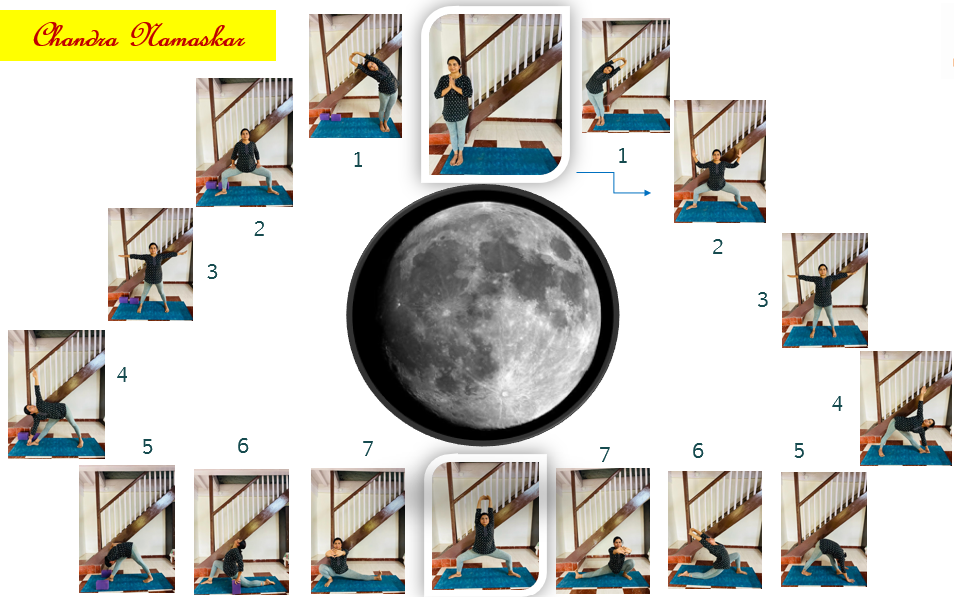
Some of the series of Asanas which we practice in Chandra Namaskar
Pranamasana ( Samasthiti)
1. Urdhwa Hasta Ardha Kati Chakrasana
2. Devyasana (Goddess Pose)
3. Utthita Tadasana
4. Trikonasana (Triangle Pose)
5. Parsvottanasana
6. Ashwa Sanchalanasana (anjaneyasana)
7. Skandasana