
Are Alternate nostril breathing and Nadi Shuddhi the Same or Different ?
The very first thing before going towards the above question is,
What is Prana ?? “Prana is the basic fabric of the whole creation”, says Prasnopanisat. The Prana is defined thus –
Verse
प्राणस्येदं वशे सर्वं त्रिदिवे यत् प्रतिष्ठितम्।
मातेव पुत्रान् रक्षस्व श्रीश्च प्रज्ञां च विधेहि न इति ॥
Transliteration
prāṇasyedaṁ vaśe sarvaṁ tridive yat pratiṣṭhitam |
māteva putrān rakṣasva śrīśca prajñāṁ ca vidhehi na iti ||
– Prasnopanisat (2-13 )
All that exists in all the three worlds is under the governance of Prana. Oh, Prana, (please) protect us, your children as a mother and grant us the (real) wealth and wisdom.
Pranayama is the practice of breath regulation, which brings about the regulation of energy in our system. It mainly corrects our breathing patterns and cleanses the nadis.Nadi is a tubular organ for the passage of prana or energy-carrying cosmic, vital, seminal and other energies, as well as sensation, intelligence, and consciousness in the causal, subtle and physical bodies. Alternate nostril breathing and balancing of breath between the two nostrils is a prerequisite to going deeper into the realms of Prana.
So very firstly if we look from the anatomy and physiological view, the nostrils are separated by the septum only up to a few inches within the nose. After that point, there is just a single airway till the lungs. There the trachea branches out into two bronchi – One into each lung. Then the question arises, how does it matter if we breathe through the left or the right??? Whichever nostril we breathe through, what is the significance behind Nadi Shuddhi Pranayama ?
Have we noticed that most of the time, only one of our nostrils is fully open, and the other is partially or fully blocked? Is that mucus blocking? If it is so, are we carrying mucus for the entire year ?? No….. What blocks the nostrils is the inflation of a soft spongy tissue, known as erectile tissue, present within the nose. This tissue follows a periodical cycle in its inflation pattern, alternating between the right and left nostrils. This is called the nasal cycle which takes 2.5 hours to reset. The nostril that is open at any time is said to be dominant one at a time. Now again the question may come: why is this tissue inflating and blocking a nostril, and why does it keep switching? What does it achieve with this? There is no rigorous answer yet from modern physiology, but yogis have found that there is a correlation between nostril dominance and several functions of the body such as left and right brain functioning, blood sugar levels, nervous system. So we can say that this tissue is an indicator of our Pranamaya Kosa, the functional body. If there is imbalance in equilibrium in energy, this tissue indicates by falling to the side where there is lesser flow of energy. It is only for a few minutes in a day that the tissue indicates equilibrium allowing both nostrils to be simultaneously open. That is the reason nostril breathing should be practiced.
According to Bihar School, there are 4 techniques of practice –
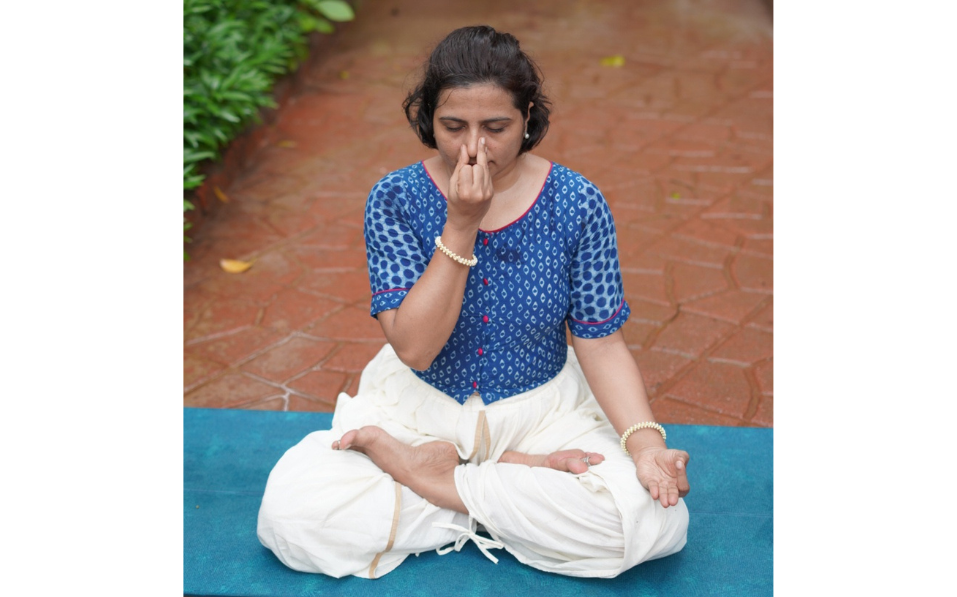
1. Nadi Shodhana Pranayama – where closing the right nostril with the thumb and fingers in nasagra mudra , inhalation and exhalation through left nostrils 5 times. After completing 5 breaths, release the pressure of the right and press the left nostril with the ring finger, blocking the flow of air. And inhalation and exhalation through the right nostril 5 times, keeping the respiration rate normal.
This is one round. In order to control the duration of each breath and master the smooth and deep breathing one should practice 5 rounds for 3 to 5 minutes.
2 .Alternate Nostril Breathing
Close the right nostril, inhale through the left once inhalation is complete, close the left nostril and exhale through the right nostril. Once equal inhalation and exhalation pattern is established, one may change the ratio as 1:2
3. With Antar Kumbhaka ( inner retention)
Following the same steps of practice only using the ratio 1:1:1with equal inhalation, inner retention and exhalation. The inner retention of breath activates various brain centres and harmonizes the prana. The benefits increase with the progression of the ratios. The ratio 1:4:2 is the most widely recommended in the yogic texts.
Here as practice goes on at an advanced level, the bandhas come into the picture. First Jalandhara and then moola bandha.
4. With Antar and Bahir Kumbhaka
Here outer breath retention is introduced. Beginning with the ratio 1:1:1:1 . Once the ratio has been perfected , gradually one can increase with the final ratio of 1:4:2:2 .
When this technique has been mastered First practice Jalandhara with both internal and external retention , then moolbandha and lastly mahabandha with addition of Uddiyana bandha.
Development of Nadi shodhana and the techniques with the ratios and counts may take many years. So here we can conclude that Nadi shodhana is a cleansing kriya. The moment you retain breath, it becomes Pranayama.
2. Hathyogapradipika by Svatmarama –
The variety of Pranayama described in this verse is not called by any particular name by Svatmarama. Other writers have, however, called it Anuloma-Viloma.
पराणं छेदिडया पिबेन्नियमितं भूयो|अन्यथा रेछयेत
पीत्वा पिङ्गलया समीरणमथो बद्ध्वा तयजेद्वामया |
सूर्य-छन्द्रमसोरनेन विधिनाभ्यासं सदा तन्वतां
शुद्धा नाडि-गणा भवन्ति यमिनां मास-तरयादूर्ध्वतः || १० ||
prāṇaṃ chediḍayā pibenniyamitaṃ bhūyo|anyathā rechayet
pītvā pingghalayā samīraṇamatho baddhvā tyajedvāmayā |
sūrya-chandramasoranena vidhinābhyāsaṃ sadā tanvatāṃ
śuddhā nāḍi-ghaṇā bhavanti yamināṃ māsa-trayādūrdhvataḥ || 10 ||
If the air is inhaled through the left nostril, it should be expelled again through the other, and filling it through the right nostril, confining it there, should be expelled through the left nostril. By practising in this way, through the right and the left nostrils alternately, the whole of the collection of the nâdîs of the yamîs (practisers) becomes clean, i.e., free from impurities, after 3 months and over.
3 . Gherandsamhita by Gherand Muni
anulomavilomen väraàväraàý ca sädhayet |
pürakänte kumbhakäntam dhrutanäsäpuöadvayamaà|
kaniñöhäanämikäåaguñaöha÷starjani madhyame vinä || 53
Alternating the nostrils practise Pranayama again and again. After Puraka hold the two nostrils with the thumb and the little and ring fingers not using the middle and index finger so long as breath is restrained.
4. Light on Pranayama by BKS Iyengar –
Nadi shodhana pranayama combines the technique of exhalation (rechaka) as in anuloma, and of inhalation (puraka) as in pratiloma pranayama. The cycle of Surya bhedana pranayama consists of inhalation through the right nostril and exhalation through the left, while in Chandra bhedana inhalation is through the left nostril and exhalation through the right. Nadi shodhana pranayama combines both into one cycle. In the advanced stages of nadi shodhana pranayamas , kumbhakas ( internal as well as external retentions) and bandhas are introduced.
After studying all the above texts and traditional references I personally feel the aim of Nadi shuddhi pranayama is to clean the nadis to prepare sadhaka for dhyana which leads to higher spiritual awakening. In the beginner stage only alternate nostril inhalation and exhalation is recommended. Once the breathing is controlled in advanced stages Kumbhakas and bandhas are to be introduced. Although names are different the sequence of practice in all texts has been mentioned in the same way. Names are secondary and given according to its effect or as per the process.
Practical experiences are more important than philosophical understandings. So practice Alternate Nostril breathing everyday to cleanse your Nadis which will lead to right living, right thinking, quick action and sound judgement !!
#Light on Pranayama#yogastudies#ancient texts#Pranayama basics#yogalearning